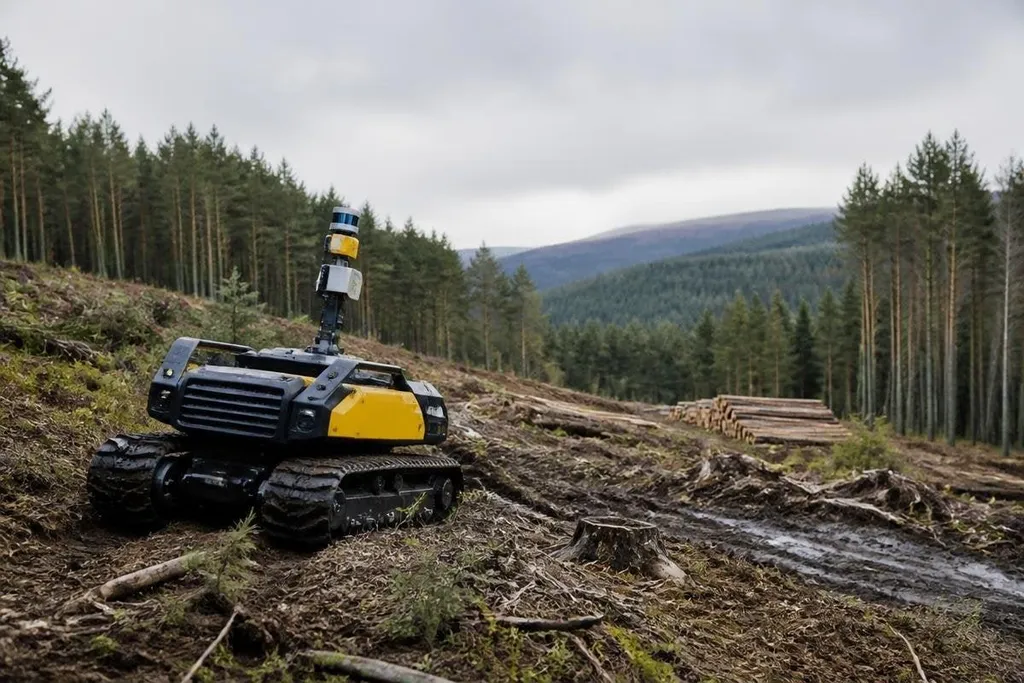
A forestry robot has to work around mud, slopes, stumps, branches, and changing weather before it earns a place in the budget. For a contractor or equipment maker, the first sale may come from safer data collection or remote work, not a machine that handles an entire harvest alone.
Quick read
- Remote inspection can be sold before full autonomy is ready.
- Fleet income may matter more than the first machine sale.
- Terrain, maintenance, and human oversight will shape the price.
Start with work that is hard to staff
Forestry has many tasks where people spend hours walking, climbing, waiting, or working near heavy equipment. A robot that maps a stand, checks a road, or finds damaged trees can reduce that time without taking over the whole operation.
That creates a service business. A contractor could charge for a survey, a map, or a repeat inspection instead of asking a customer to buy a robot. The customer pays for a result, while the contractor handles charging, transport, software, and repairs.
The same model can fit machines that inspect culverts, monitor fences, or check young trees after planting. Each task needs a clear output, such as a map with marked faults or a list of trees that need attention. Without that output, a robot is another machine waiting for instructions.
The machine must fit the forest
A forestry robot needs more than wheels and a camera. Its design has to match the ground, the job, and the way workers already move equipment through a site.
Tracked drive can help on soft ground, while a narrow body may matter on rough access roads. LiDAR, which measures distance with laser pulses, can build a map when satellite signals are weak beneath trees.
A thermal camera may help find heat from a machine fault, but it won't replace a person who can inspect the part and decide what to do.
Power is another business issue. A battery robot that needs frequent transport back to a charger may save little time on a remote site. A contractor should price the full work cycle: loading, travel, setup, operation, recovery, cleaning, and service.
The useful unit of measure is the job. Ask how many hectares a crew can inspect in a day, how long the robot takes to cover the same ground, and how often a person must take control. A speed claim without those details says little.
Where the revenue can come from
A maker can sell the machine, rent it, or charge for completed work. Rental lowers the first cost for small contractors, while a service contract can give the maker income after delivery. Repairs, spare batteries, sensor checks, and software support may matter as much as the first invoice.
That choice also changes who carries the risk. With a sale, the buyer owns the downtime. With a service model, the maker must keep the robot working and send help when a track breaks or a sensor fills with dirt.
The service model makes repair records part of the buying decision. Buyers can follow forestry robotics coverage from Robot24.com for named machines, field tests, and the work left to crews. That evidence helps them compare a robot with the labor cost they already know.
The strongest early customers may be firms that already have trained crews, transport vehicles, and repeat contracts. They can compare a robot with a known labor cost instead of trying to build a new service around an untested machine.
The limits buyers will test first
Forestry work changes from one site to the next. A robot trained on clear ground may struggle when the path is covered by slash, wet leaves, or fallen branches. Remote control can help, but the business still needs a reliable link, a safe stop, and a person who can reach the machine.
Insurance and site rules will matter too. A machine working near harvesters, trucks, and people needs clear control boundaries. A buyer will ask who is responsible when the robot damages a tree, blocks a road, or stops far from the loading point.
I'd wait before buying any forestry robot that can't show its work rate across the ground you manage. A clean demonstration on a prepared track proves the sensors can work; it doesn't prove the service will pay for itself.
A buyer's decision check
Use these questions before signing a purchase or service deal:
- Name the job the robot will complete and the report or result it will produce.
- Measure the full site cycle, including transport, setup, cleaning, charging, and recovery.
- Set a human-control plan for weak signals, blocked paths, sensor faults, and injuries.
- Price repairs, batteries, software, insurance, and staff time beside the machine cost.
- Test on the steepest, wettest, and most cluttered ground the contract includes.
The business case will be strongest where a robot repeats a costly task, records a useful result, and keeps people away from avoidable hazards. The open question is how many forestry operators will pay for that service before a machine can work a full shift without close supervision.